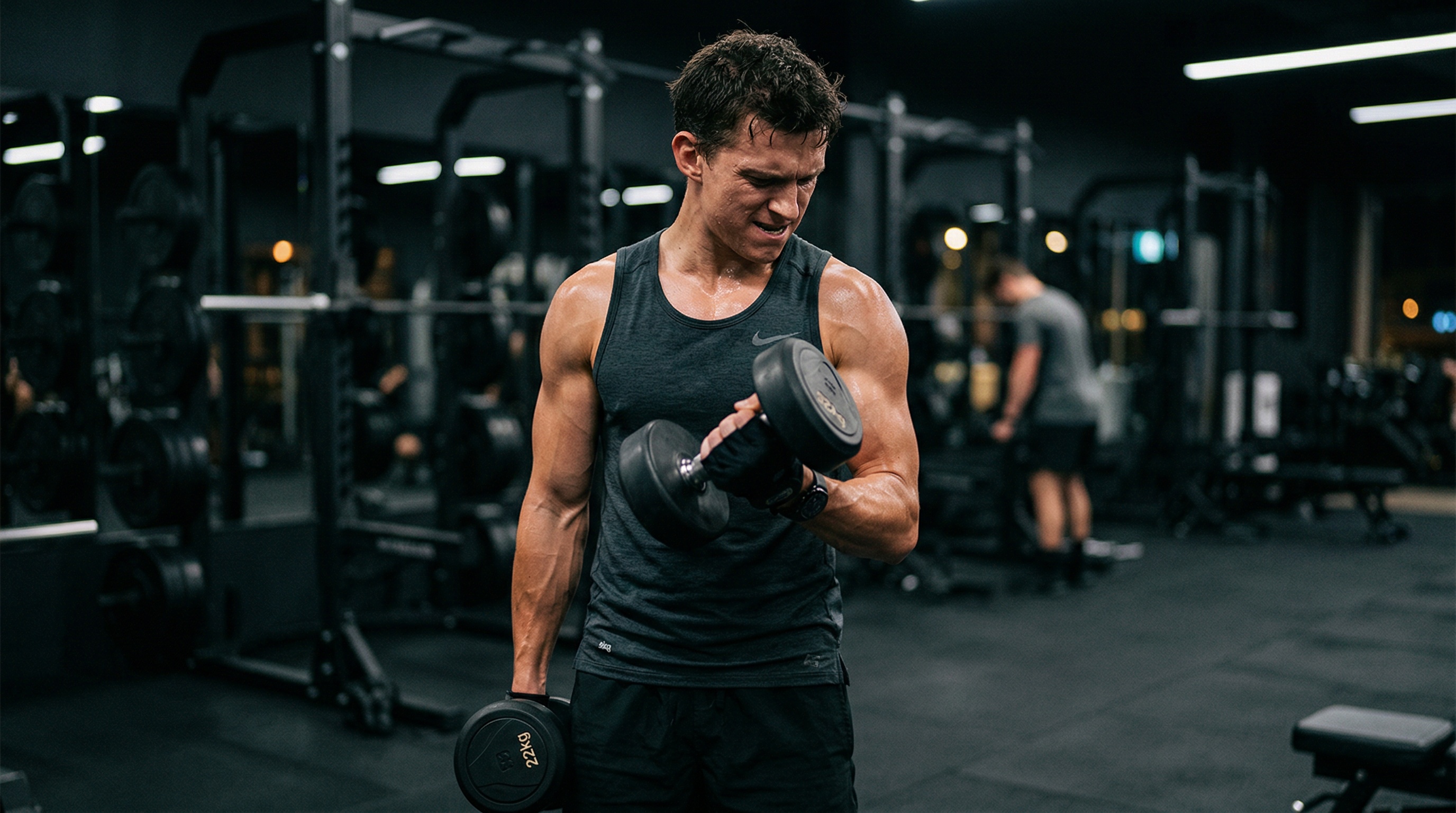
Tom Holland Workout: The Spider-Man Training Routine
How Tom Holland built an acrobatic, camera-ready physique through gymnastics, bodyweight mastery, and targeted hypertrophy.
Tom Holland brings something to the Spider-Man role that no previous actor has fully achieved: genuine physical credibility. At 5'8" and 155 pounds, he's not the largest superhero in the Marvel Cinematic Universe — not even close. But Holland moves with an effortless acrobatic fluency that makes the character's web-slinging, wall-crawling, backflip-executing world feel plausible in a way that pure muscle mass never could have. That movement quality didn't come from the gym alone. It came from a training background that predates the MCU by years and a physical preparation approach that treats Spider-Man as an athlete first, a spectacle second. Holland's movement foundation was laid long before he was cast as Peter Parker. He trained seriously in gymnastics and dance from a young age, attending the Nifty Feet Dance School in London and later training full-time in preparation for the lead role in Billy Elliot the Musical in the West End. This background gave him an extraordinary proprioceptive baseline — the ability to understand and control where his body is in three-dimensional space — that most gym-trained actors simply don't have. When Marvel asked him to perform aerial sequences and stunt rehearsals, Holland wasn't learning a foreign language. He was adding vocabulary to a language he already spoke fluently. His primary trainer for the Spider-Man films has been George Ashwell, a London-based trainer who has developed a program that honors and builds upon Holland's existing movement skills while adding the upper body muscle mass required for the superhero look. Ashwell's challenge was nuanced: Holland needed to be bigger than his natural frame would suggest, but not so mass-heavy that it impeded the gymnastics work that makes Spider-Man visually distinct from every other MCU character. The sweet spot — muscular, defined, but lightweight and explosive — is considerably harder to achieve than simply getting as big as possible. Ashwell's program integrates gymnastics ring work, bodyweight progressions, and targeted hypertrophy training in a way that reinforces rather than conflicts with Holland's movement work. The rings are particularly significant: working on gymnastics rings builds extraordinary shoulder and core stability, develops pulling strength through a full range of motion, and creates the interconnected upper body musculature that reads well both in still photography and in dynamic action sequences. Holland has been photographed and filmed on rings extensively, and the shoulder development they produce — round, stable, connected — is noticeably different from the deltoid development produced by conventional pressing. For No Way Home, the physical demands were particularly interesting because the film required Holland's Peter Parker to feel authentically mature — a teenager who had spent years fighting as an Avenger and had the body to prove it. The prep reflected this narrative: Ashwell pushed Holland's upper body development further than previous Spider-Man films, adding meaningful mass to his chest, shoulders, and back while maintaining the mobility and agility that define the character's movement style. The result was the most muscularly developed Holland had appeared in any of his Spider-Man appearances. Holland's cardio and conditioning approach is built around his stunt work rather than traditional cardiovascular exercise. Learning and rehearsing stunt sequences is extraordinarily demanding metabolically — full-body explosive movement repeated dozens of times through lengthy rehearsal sessions builds the kind of conditioning that running on a treadmill simply doesn't approximate. Holland has spoken about how physical the stunt rehearsal process is and how it contributes to maintaining a lean body composition through the production period, essentially turning work into conditioning. Nutrition for Holland follows a lean-bulk philosophy during pre-production: enough of a caloric surplus to support muscle development while the training volume and stunt work prevent excessive fat gain. He prioritizes protein to support the hypertrophy work Ashwell programs, manages carbohydrates around training sessions, and keeps diet simple and consistent rather than elaborate. During filming, nutrition tightens slightly as Ashwell shifts the focus from building to maintaining, ensuring Holland looks his best on camera while his energy demands remain high from physical production days. The sleep and recovery component of Holland's training is worth emphasizing, particularly because young athletes often underweight it. Holland is in his late twenties but still at an age where recovery capacity is high, and Ashwell programs around this asset — pushing volume and intensity during prep phases while ensuring Holland has the sleep and down time to convert that training stimulus into actual adaptation. Holland has been open about prioritizing mental health alongside physical training, understanding that sustainable performance requires emotional and psychological resources as much as physical ones. What makes Holland's physical approach genuinely instructive for average people is the emphasis on movement quality over raw metrics. Most gym programs are organized around numbers — how much you lift, how big your arms are, how low your body fat is. Ashwell programs Holland around what his body can do: how fluidly it can move, how stable his shoulders are under load, how well his core transfers force in multiple planes. If you incorporate bodyweight mastery, ring work, and agility training into your program alongside conventional lifting and track it all in BasedHealth, you'll build a physique that performs as well as it looks — which is exactly the brief Tom Holland walks into every Spider-Man production.
BasedHealth Fitness Team
NSCA & ACSM-guided programming
This program is based on publicly available training interviews and adapted using evidence-based principles from the National Strength & Conditioning Association and American College of Sports Medicine guidelines. Always consult a physician before starting a new fitness program.
The Training Philosophy
Understand the science behind the transformation
A 4-day program that blends gymnastics ring work, bodyweight strength progressions, and targeted hypertrophy training under trainer George Ashwell. Sessions emphasize movement quality, shoulder stability, and explosive athleticism alongside conventional muscle building, producing a physique optimized for performance rather than pure size.
Key Training Principles
Progressive Overload
Gradually increase intensity for continuous gains
Recovery Focus
Strategic rest periods for optimal muscle growth
Nutrition Synergy
Diet perfectly aligned with training goals
The Complete Workout Plan
Follow this exact routine to achieve Tom Holland's physique
Track every set, rep, and rest period with our app
Start Tracking NowGymnastics Ring Dip
Sets
4
Reps
8-10
Rest
90 sec
Ring Row
Sets
4
Reps
10-12
Rest
75 sec
Handstand Push-Up
Sets
3
Reps
6-8
Rest
2 min
Weighted Chin-Up
Sets
4
Reps
6-8
Rest
90 sec
Pistol Squat
Sets
3
Reps
6-8
Rest
90 sec
L-Sit Hold
Sets
4
Reps
10-15 sec hold
Rest
60 sec
Pike Push-Up to Downdog
Sets
3
Reps
12-15
Rest
60 sec
Plyo Push-Up
Sets
3
Reps
8-10
Rest
90 sec
The Nutrition Protocol
Fuel your transformation with the right diet
Daily Macro Targets
Protein
Carbs
Fats
Track your calories and macros effortlessly with AI-powered food recognition
Start Tracking Your NutritionCommon Questions
How did Tom Holland prepare for Spider-Man physically?
Does Tom Holland do gymnastics?
Who is Tom Holland's trainer for Spider-Man?
How much does Tom Holland weigh as Spider-Man?
What bodyweight exercises did Tom Holland do for Spider-Man?
Pair This Workout With a Meal Plan
Training without a nutrition plan is wasted effort. These meal plans match this program's calorie needs.
Meal Plan for Muscle Gain: High Calorie Bulking Guide
A 2800-calorie bulking plan designed to build lean muscle mass efficiently.
View 7-day plan →
3000 Calorie Meal Plan: Mass Building Guide
A high-volume 3000-calorie plan for building serious mass through structured, nutrient-dense eating.
View 7-day plan →
High Protein Meal Plan: Build Muscle & Stay Full
A high-protein plan delivering 180g+ protein daily for muscle building and satiety.
View 7-day plan →
Track The Foods In This Plan
Quick calorie and macro references for the staples in this workout's nutrition protocol.
Ready to Transform Like Tom Holland?
Join thousands using our AI-powered app to track workouts and nutrition effortlessly