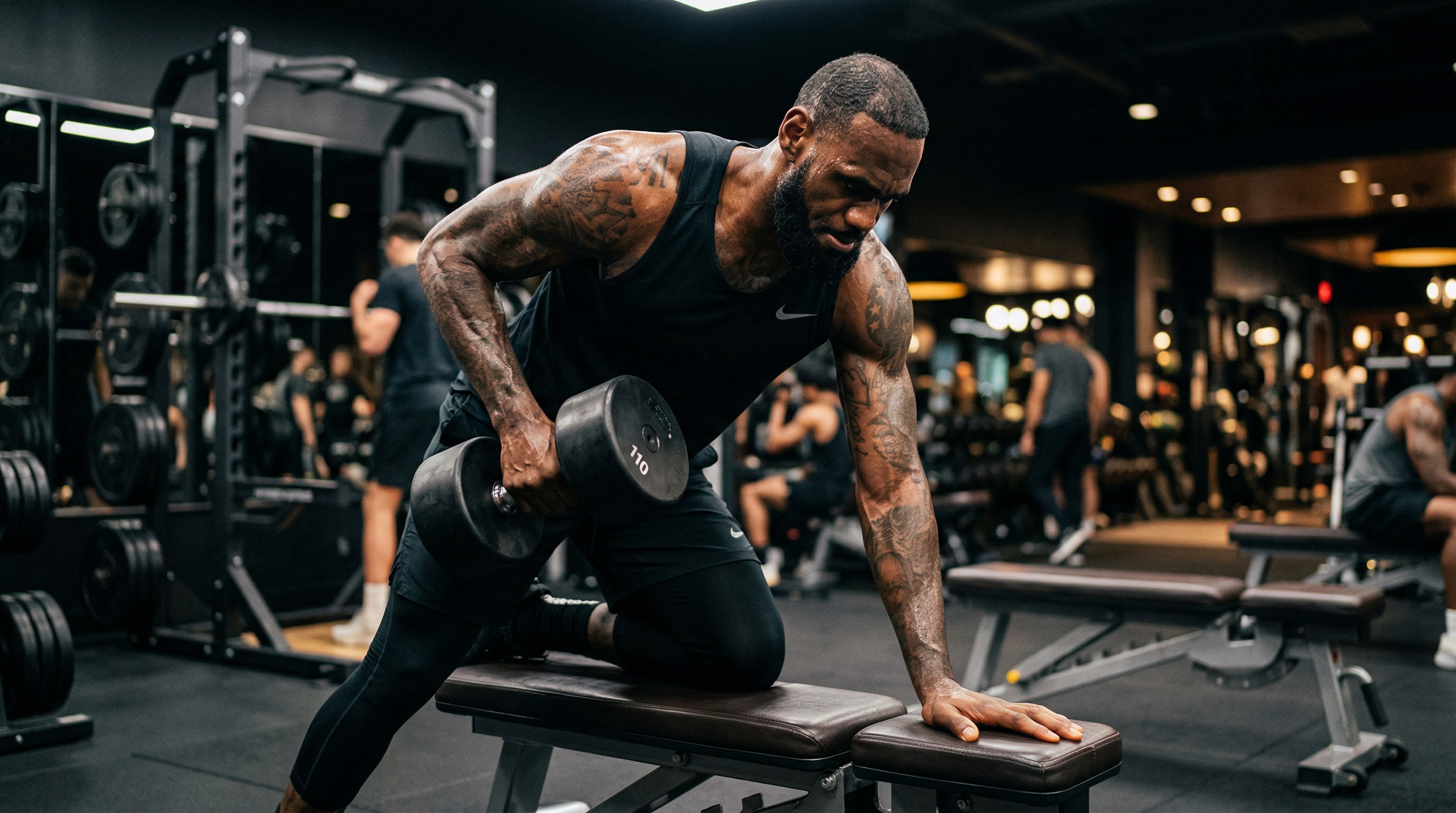
LeBron James Workout: The $1.5M/Year Body Maintenance Program
Inside the most sophisticated athletic maintenance operation in professional sports — sleep science, Pilates, recovery technology, and why LeBron is still elite at 40
LeBron James spends approximately $1.5 million per year on his body. This is not hyperbole — it is a matter of documented record, confirmed by his trainer Mike Mancias and discussed openly by LeBron himself in various interviews. The expenditure covers a personal chef, a sleep biometrics specialist, cryotherapy equipment installed in his home, a hyperbaric chamber, personal massage therapists, and a training infrastructure that would be more appropriate for a professional sports franchise than a single athlete. It is also, by any reasonable cost-benefit analysis, the best investment he has ever made. At 6'9" and 250 pounds, LeBron James at age 39-40 is doing something that sports science has historically suggested shouldn't be possible: competing at the absolute highest level of a sport that ruthlessly metabolizes athletic ability, maintaining the explosive power and body composition that characterized his career at age 22. The physical requirements of professional basketball — the lateral quickness, vertical explosion, sprinting acceleration, collision tolerance, and four-quarter endurance — typically begin degrading meaningfully in the late twenties. LeBron has responded to this conventional wisdom by essentially ignoring it. The cornerstone of LeBron's longevity program is sleep. He famously sleeps eight to ten hours per night plus naps, using sleep tracking technology to monitor sleep quality and optimize recovery. This is not a casual preference — sleep is the single most powerful recovery modality available to athletes, and LeBron treats it with the same methodical discipline he applies to every other aspect of physical preparation. He has consistently cited sleep as the most important factor in his ability to maintain performance across a twenty-year professional career. The training program itself, overseen by longtime trainer Mike Mancias, reflects a sophisticated understanding of athletic longevity that prioritizes joint health and movement quality alongside raw strength and power development. LeBron incorporates Pilates as a regular practice — a somewhat unusual choice for an NBA player but a logical one given Pilates' emphasis on core stability, spinal alignment, and the hip mobility that is critical for LeBron's specific offensive game. The Pilates work addresses the small stabilizer muscles that conventional strength training doesn't reach, building the joint stability that is essential for someone absorbing the physical contact of NBA competition over a full season. The strength training component is built around compound movements that develop functional power — the ability to produce force quickly and explosively in the multi-directional patterns that basketball requires. LeBron's weight room work emphasizes hip-dominant movements, single-leg exercises for the balance and unilateral strength that court movement demands, and upper-body compound lifts that maintain the physical presence to operate in the post and absorb contact. At his size and muscle mass, maintaining strength is relatively straightforward; the challenge is maintaining the mobility and joint health that allows that strength to be expressed athletically. Nutrition is managed by his personal chef, who has described preparing approximately twelve meals and snacks per day for LeBron during the season. The approach is aggressively anti-processed, emphasizing whole foods, lean proteins, complex carbohydrates, and healthy fats in quantities and timing calibrated to the specific energy demands of game days versus off days versus heavy practice days. LeBron has been documented to be meticulous about what goes into his body, understanding that at his level of performance, nutritional optimization is not optional. The recovery technology LeBron employs would have been science fiction twenty years ago. Cryotherapy chambers (exposure to temperatures around -200°F for three minutes) to reduce systemic inflammation. NormaTec compression boots for leg recovery. Hyperbaric oxygen therapy to accelerate healing of minor injuries. Regular massage and soft-tissue work to address the cumulative physical stress of professional competition. Infrared saunas for cardiovascular recovery. This infrastructure doesn't replace training — it allows more training by compressing the recovery window between sessions. The philosophical dimension of LeBron's approach deserves acknowledgment. He has approached his own athletic longevity as a solvable problem — a complex optimization challenge that can be systematically addressed through adequate investment of time, money, and information. This mindset is arguably his most transferable lesson. Most people cannot afford a personal chef or a hyperbaric chamber, but everyone can prioritize sleep, eat minimally processed food, train consistently, and take recovery as seriously as training. The principles of LeBron's program are universally applicable even when the resources are not.
BasedHealth Fitness Team
NSCA & ACSM-guided programming
This program is based on publicly available training interviews and adapted using evidence-based principles from the National Strength & Conditioning Association and American College of Sports Medicine guidelines. Always consult a physician before starting a new fitness program.
The Training Philosophy
Understand the science behind the transformation
A year-round maintenance and performance program overseen by trainer Mike Mancias, combining strength and power training with Pilates, extensive recovery technology, sleep optimization, and personalized nutrition — the most comprehensive athletic maintenance operation in professional sports.
Key Training Principles
Progressive Overload
Gradually increase intensity for continuous gains
Recovery Focus
Strategic rest periods for optimal muscle growth
Nutrition Synergy
Diet perfectly aligned with training goals
The Complete Workout Plan
Follow this exact routine to achieve LeBron James's physique
Track every set, rep, and rest period with our app
Start Tracking NowTrap Bar Deadlift
Sets
4
Reps
5-6
Rest
3 min
Single-Leg Squat (Pistol Progression)
Sets
3
Reps
8 each leg
Rest
2 min
Landmine Squat
Sets
3
Reps
12
Rest
90 sec
Pilates Reformer Leg Circle
Sets
3
Reps
10 each direction
Rest
45 sec
Band Pull-Apart
Sets
4
Reps
25
Rest
30 sec
Glute Bridge with Hip External Rotation
Sets
3
Reps
15
Rest
60 sec
Dead Bug
Sets
3
Reps
10 each side
Rest
45 sec
Sled Push
Sets
6
Reps
20 meters
Rest
90 sec
The Nutrition Protocol
Fuel your transformation with the right diet
Daily Macro Targets
Protein
Carbs
Fats
Track your calories and macros effortlessly with AI-powered food recognition
Start Tracking Your NutritionCommon Questions
How much does LeBron James spend on his body per year?
How many hours does LeBron James sleep per night?
Does LeBron James really do Pilates?
What recovery methods does LeBron James use?
How is LeBron James still elite at age 39-40?
Pair This Workout With a Meal Plan
Training without a nutrition plan is wasted effort. These meal plans match this program's calorie needs.
Meal Plan for Muscle Gain: High Calorie Bulking Guide
A 2800-calorie bulking plan designed to build lean muscle mass efficiently.
View 7-day plan →
3000 Calorie Meal Plan: Mass Building Guide
A high-volume 3000-calorie plan for building serious mass through structured, nutrient-dense eating.
View 7-day plan →
High Protein Meal Plan: Build Muscle & Stay Full
A high-protein plan delivering 180g+ protein daily for muscle building and satiety.
View 7-day plan →
Track The Foods In This Plan
Quick calorie and macro references for the staples in this workout's nutrition protocol.
Ready to Transform Like LeBron James?
Join thousands using our AI-powered app to track workouts and nutrition effortlessly