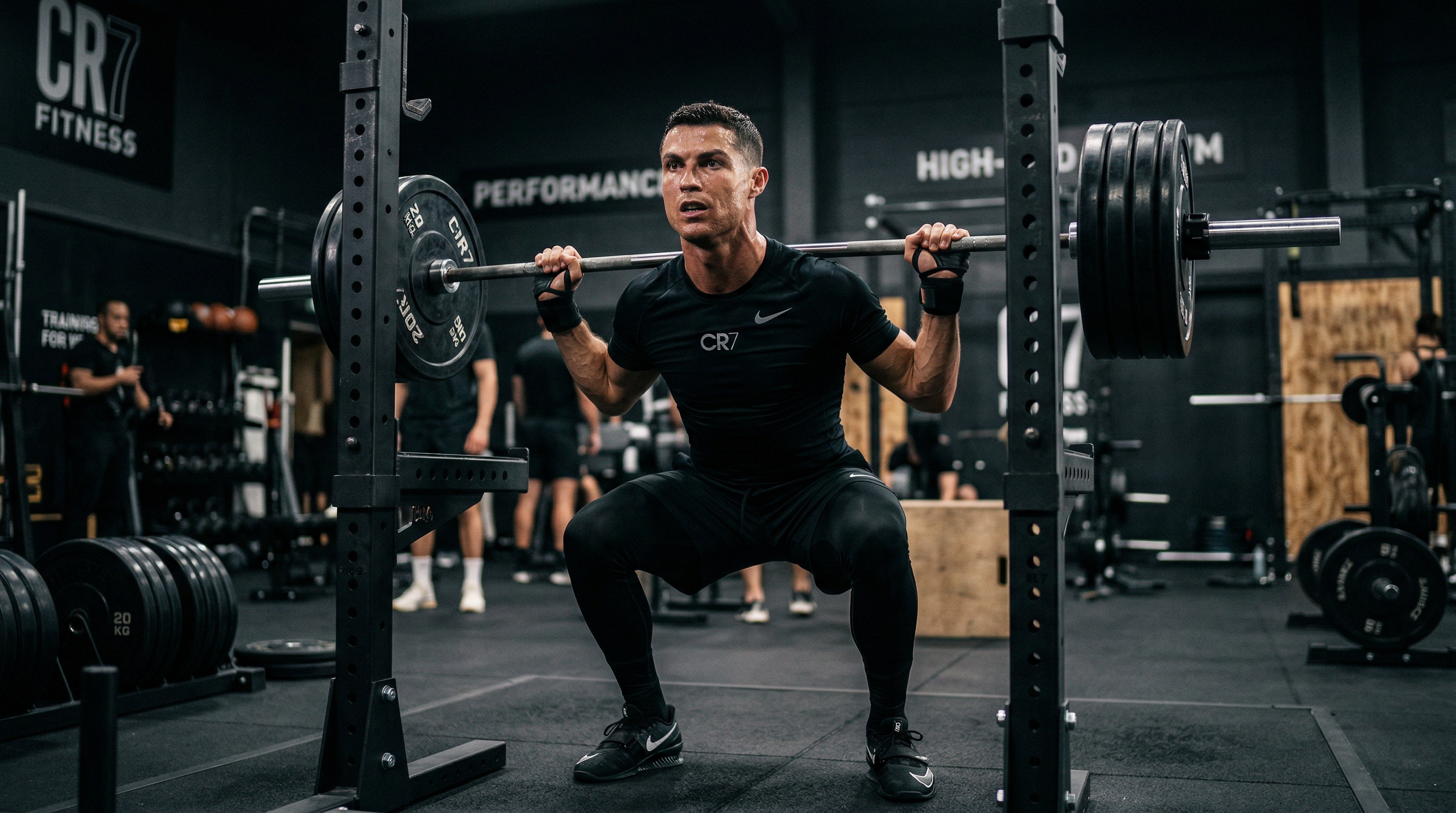
Cristiano Ronaldo Workout: The Training Program Behind the World's Fittest Footballer
How Cristiano Ronaldo maintains sub-7% body fat and elite athleticism at 41 through obsessive training and precision nutrition
Cristiano Ronaldo is, by virtually every objective measure, the most physically prepared professional athlete of his generation. At 41 years old — an age at which most footballers have been retired for a decade — he maintains a physique and level of performance that would be exceptional for athletes in their mid-20s. His body fat percentage has been measured at sub-7% during season, his vertical jump exceeds 78 centimeters (higher than most NBA players), his sprint speed remains elite, and his work rate in matches consistently ranks among the highest in professional football. None of this happened by accident. The foundation of Ronaldo's physical dominance is a training philosophy built on obsessive attention to detail across every variable that influences athletic performance. His former Manchester United and Real Madrid teammates have described his approach with a mixture of admiration and disbelief — arriving first to training, leaving last, spending additional hours in the gym after full team sessions, sleeping in structured 90-minute sleep cycles rather than a continuous 8-hour block, and subjecting himself to cryotherapy, massage, and recovery protocols that treat physical maintenance as seriously as the training itself. His training volume during the competitive season is genuinely extraordinary. Reports from coaches and former teammates suggest he performs 3,000 or more sit-ups daily, though this figure refers to total abdominal work spread across multiple sessions rather than a single continuous bout. His core training philosophy is that the abdominals are the center of athletic movement and must be trained with the same seriousness as any other athletic quality. Whether or not the exact numbers are precise, the result — visible abdominal definition at sub-7% body fat in a contact sport athlete in his 40s — speaks to the effect. Speed and explosive power have been central concerns throughout his career. Ronaldo works extensively on plyometric training, sprint mechanics, and jump development, understanding that football at the highest level is a game of explosive moments. His famously high vertical leap — demonstrated most spectacularly in his Champions League header against Sampdoria, in which he appeared to momentarily hang in the air — is the product of deliberate, programmed plyometric work and not simply natural ability. The same athlete who at 17 was physically slight and dependent on technical skill has systematically built himself into one of the most powerful physical specimens in the sport. Strength training in Ronaldo's program is divided between heavy compound work and more targeted functional exercises. He squats, deadlifts, and presses, but his loading and rep schemes are oriented toward athletic power development rather than maximum hypertrophy. He is not trying to be the biggest person in the room — he is trying to be the most explosive, with sufficient muscle mass to win physical duels and maintain strength endurance across a 90-minute match plus additional knockout rounds in tournament scenarios. His dietary approach is one of the most studied and discussed in professional sport. Ronaldo reportedly eats six small meals per day rather than three larger ones, keeping his metabolism elevated and his energy supply constant throughout the day. His diet is heavily weighted toward lean proteins and complex carbohydrates, with minimal processed foods, alcohol (he has been teetotal for much of his career), and sugar. He is documented as having removed sugar from his diet almost entirely and has discussed the role of chicken, fish, eggs, and fresh vegetables as his dietary staples. His pre-match nutrition is carefully timed to ensure glycogen availability for the explosive efforts football demands. The mental dimension of Ronaldo's preparation is inseparable from the physical. He is famous for visualization practices, spending time before matches mentally rehearsing specific scenarios — free kick trajectories, penalty techniques, movement patterns. This psychological preparation extends to how he approaches training: every session has a purpose, every set has an intent, and there is no tolerance for unfocused effort. His former coaches at United and Real Madrid consistently described him as the most mentally prepared player they had encountered, someone who treats a midweek league match with the same psychological preparation as a Champions League final. Sleep is treated with extraordinary seriousness. Ronaldo works with sleep coach Nick Littlehales, who has helped him structure his sleep into five 90-minute cycles across both nighttime sleep and daytime naps, totaling 7.5 hours of sleep per day. This approach, which aligns sleep periods with the natural 90-minute ultradian rhythm of the brain, is designed to maximize sleep quality rather than simply duration. The result is recovery that supports the training volume he maintains without the accumulated fatigue that typically limits athletes' careers into their mid-30s.
BasedHealth Fitness Team
NSCA & ACSM-guided programming
This program is based on publicly available training interviews and adapted using evidence-based principles from the National Strength & Conditioning Association and American College of Sports Medicine guidelines. Always consult a physician before starting a new fitness program.
The Training Philosophy
Understand the science behind the transformation
A comprehensive performance program combining heavy strength work, explosive plyometrics, football-specific conditioning, and high-volume core training. Up to 5 sessions per day during peak season, integrating individual training with team sessions. Recovery is treated as training and receives equal investment.
Key Training Principles
Progressive Overload
Gradually increase intensity for continuous gains
Recovery Focus
Strategic rest periods for optimal muscle growth
Nutrition Synergy
Diet perfectly aligned with training goals
The Complete Workout Plan
Follow this exact routine to achieve Cristiano Ronaldo's physique
Track every set, rep, and rest period with our app
Start Tracking NowBarbell Squat
Sets
4
Reps
6-8
Rest
2 min
Box Jump
Sets
5
Reps
8-10
Rest
90 sec
Weighted Sit-Ups
Sets
10
Reps
30
Rest
30 sec
Sprint Intervals (10m/30m)
Sets
8
Reps
10 sprints each distance
Rest
90 sec
Romanian Deadlift
Sets
4
Reps
8-10
Rest
90 sec
Lateral Bound
Sets
4
Reps
10 each side
Rest
60 sec
Bench Press
Sets
4
Reps
8-10
Rest
90 sec
Cryotherapy / Ice Bath
Sets
1
Reps
10-15 min
Rest
None
The Nutrition Protocol
Fuel your transformation with the right diet
Daily Macro Targets
Protein
Carbs
Fats
Track your calories and macros effortlessly with AI-powered food recognition
Start Tracking Your NutritionCommon Questions
How many sit-ups does Cristiano Ronaldo do per day?
What is Cristiano Ronaldo's body fat percentage?
How many times a day does Cristiano Ronaldo train?
What does Cristiano Ronaldo eat in a day?
How does Cristiano Ronaldo sleep?
Pair This Workout With a Meal Plan
Training without a nutrition plan is wasted effort. These meal plans match this program's calorie needs.
Meal Plan for Muscle Gain: High Calorie Bulking Guide
A 2800-calorie bulking plan designed to build lean muscle mass efficiently.
View 7-day plan →
3000 Calorie Meal Plan: Mass Building Guide
A high-volume 3000-calorie plan for building serious mass through structured, nutrient-dense eating.
View 7-day plan →
High Protein Meal Plan: Build Muscle & Stay Full
A high-protein plan delivering 180g+ protein daily for muscle building and satiety.
View 7-day plan →
Track The Foods In This Plan
Quick calorie and macro references for the staples in this workout's nutrition protocol.
More Celebrity Workouts
Ready to Transform Like Cristiano Ronaldo?
Join thousands using our AI-powered app to track workouts and nutrition effortlessly